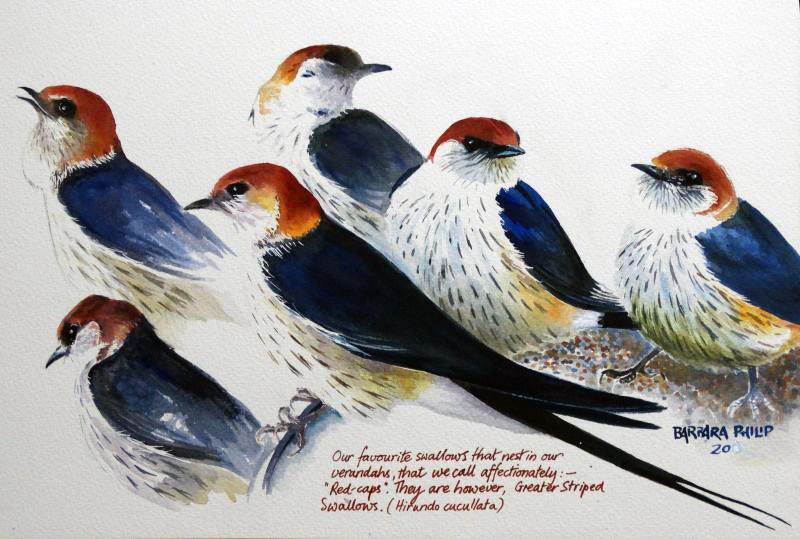
We are always delighted when our favourite swallows, the Greater Striped Swallow ( Hirundo Cucullata ) arrives for the summer. We love their contented warbling song/chatter, and wistful call. Now that the summer is almost over, they will soon be leaving for northern parts. They are delightful residents of our verandahs, with their mud nests characterized by long tunnel entrances. We call them ‘Red Caps’ due to the russet colouring on the top of their heads. This year, I was able to get some good photos of them, which inspired this little study. We also have the Whitethroated Swallow, ( Hirundo Albigularis ) , but the Red Caps are our favourites.
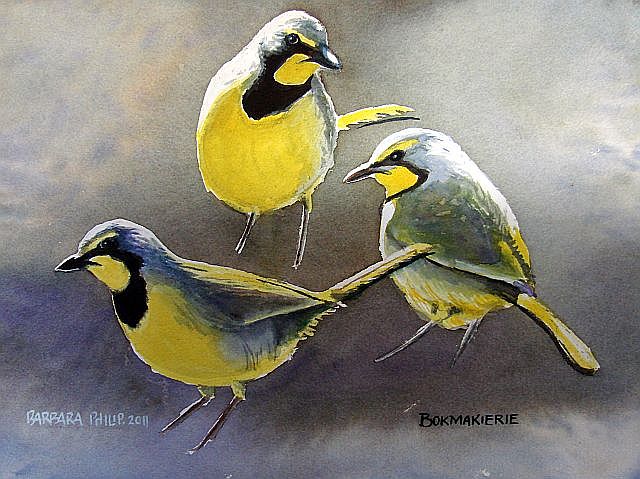
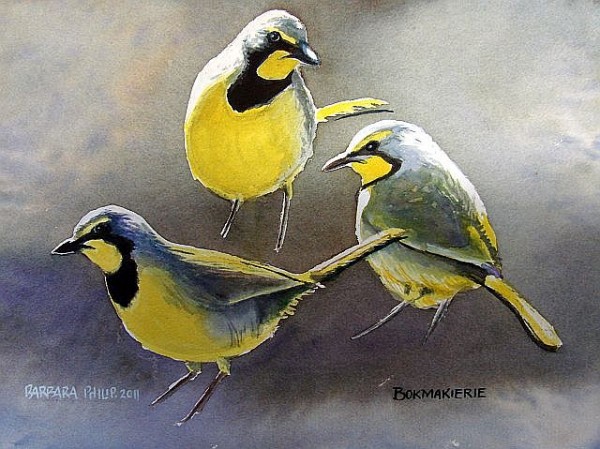
The beautiful Bokmakierie belongs the Bush Shrike family and is such a colourful resident of our otherwise drab winter garden. Although they live and nest here, it is seldom that I am able to photograph them. How lucky I was, and of course a sketch was inevitable !
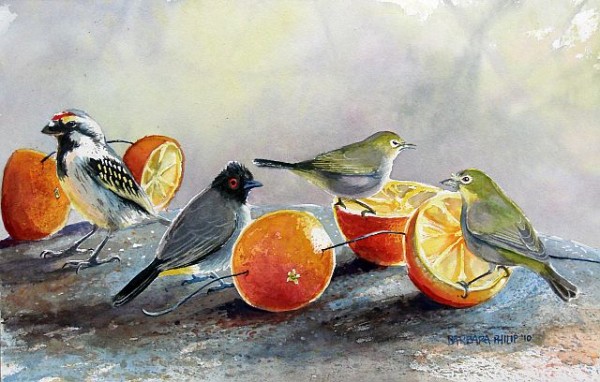
Some time ago I posted a blog featuring the seed-eaters under the title; ‘Feeding the Birds’. I really love the birds, so I continue to photograph them in and around our garden. Those that come to the bird table outside my studio window are a wonderful and colourful distraction. We feed them seeds and crushed maize, bread crusts, grated cheese, dry cooked maize porridge called, ‘Umphokoqo’, and fruit. The oranges have to be attached with wire to keep them from falling onto the ground below.
Crested Barbet. Watercolour & Gouache 470 x 285 mm.
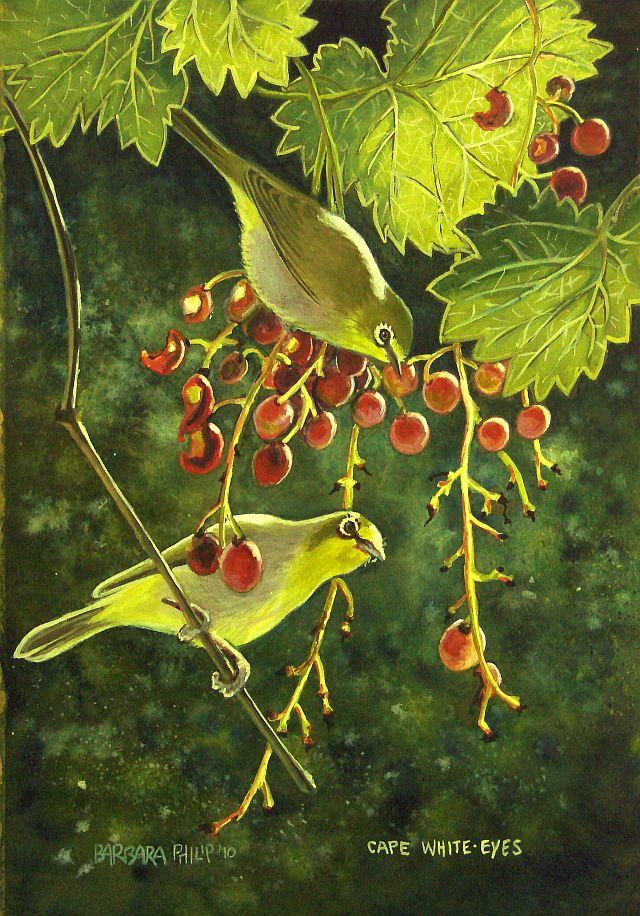
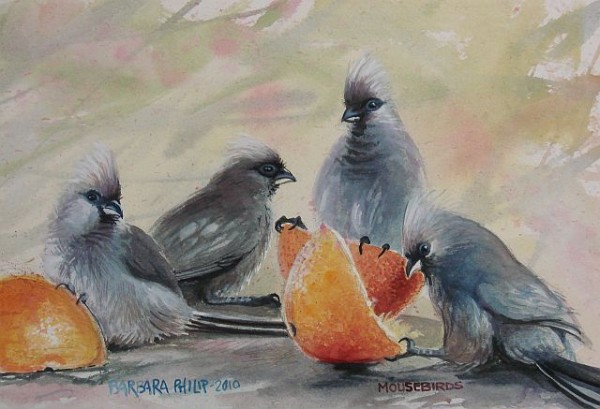
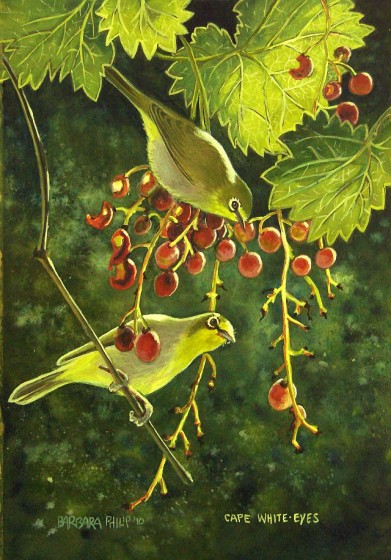
As it is the fruit-salad season at the moment, with oranges and paw-paws in abundance, I have kept the fruit–eating birds happy with all the fruit-skins that they enjoy. The first birds that come for them include; the Crested and Pied Barbets, the Mousebirds, The Red-eyed Bulbuls and many more. The Crested Barbet is so bright and cheerful while all around winter hues still drape the garden in sombre tones of ochre and grey, and the seed-eating weavers have yet to clothe themselves in their bright breeding plumage of red and yellow. Therefore I decided to make a small study of some of these fruit-eaters. The bright and dainty Cape White-eyes are my favourites, so I chose two compositions with them.
Mousebirds with Oranges. Watercolour. 385 x 265 mm.Cape White-eyes on the Grapevine. Watercolour & Gouache. 290 x 420 mm.
The regular ritual of feeding the birds inspired this latest set of pictures.
Sketch of The Birds Feeding
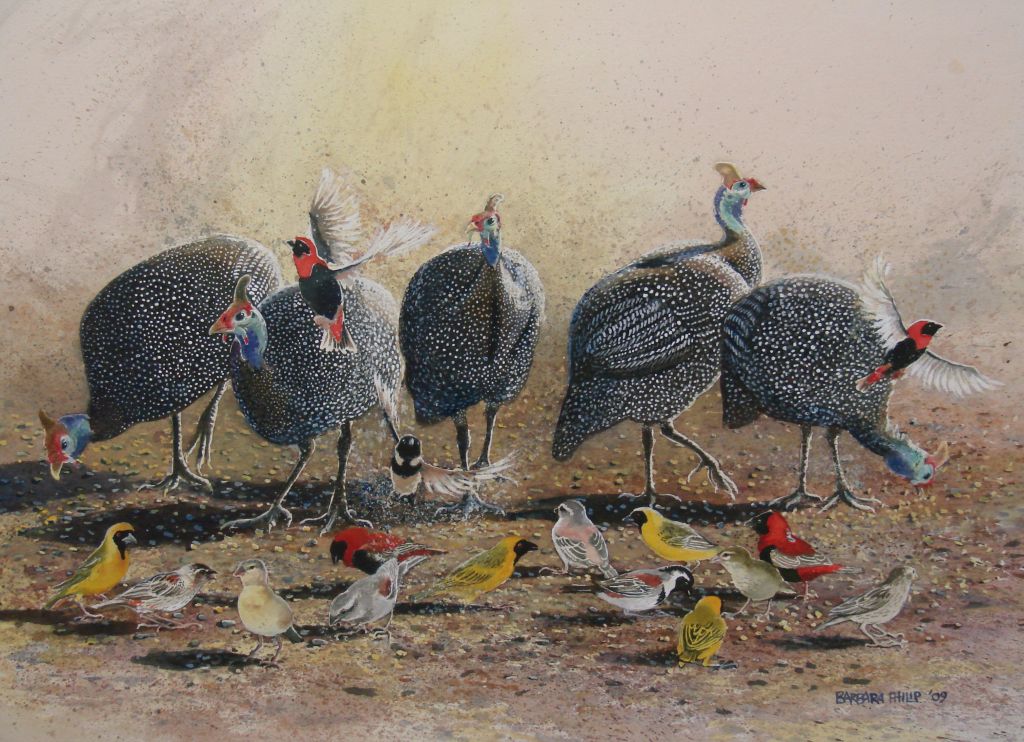
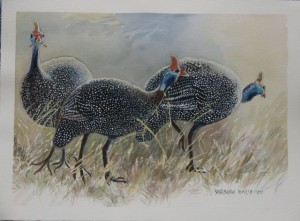
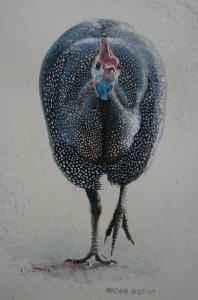
Several years ago we raised guinea fowls from eggs found in the Lucerne lands, and rescued them before the tractor went over their nests. We set them under broody hens, which successfully reared the large clutches of young guineas. When they grew up, they re-joined the wild flocks that live around here. But they always return when they get hungry, and many of the other weavers, sparrows and doves have enthusiastically taken to the daily feeding and arrive in large numbers to mingle with the guinea fowl.
Three Guinea Fowl arriving for feeding time
A quote from the Evangelical priest and scholar John Stott who wrote a sermon series called; “The Birds our Teachers”.
“Jesus himself referred to birds in his famous Sermon on the Mount. According to the old English version he said ‘consider the fowls of the air’, but in basic English this is a command to ‘watch birds’. When Martin Luther, the great 16th century reformer, got to this verse in his commentary on the Sermon on the Mount, he became quite lyrical. He wrote: ‘Let the little birds be your theologians … We have as many teachers and preachers as there are little birds in the air’. So I’ve sometimes said in rather jocular fashion that I’m developing a new science called ‘orni-theology’, – the theology of birds.”
'Feeding The Birds', (50 x 70 cms)Watercolour on Saunders Waterford.
Overheard In An Orchard
Single Guinea waiting for the seed
Said the Robin to the Sparrow
“I would really like to know
Why these anxious human beings
Rush about and worry so.”
Said the Sparrow to the Robin
“Friend I think that it must be
That they have no Heavenly Father
Such as cares for you and me.”